Rehabilitation of coastal sands in the fynbos region

Plants on the fore-dunes have developed all sorts of strategies to survive in what are very harsh conditions. The plants are adapted to growing with little available soil water (they either have shallow, extensive and much branched or very deep root systems), desiccation (they use all sorts of tricks to reduce transpiration including hairy leaves, sunken stomata, and ability to roll their leaves), burial (they just keep growing), high temperatures (adult plants are adapted to withstand burning sands but seedlings should be allowed to establish during the cooler months) and salt-laden winds (coastal plants often have a waxy cuticle and/or hairy leaves).

While adult plants typically can withstand the harshest conditions on the coast and may loose leaves or new growth at certain times of the year (be wind-pruned), exposed seedlings will often die under these conditions. There are therefore three main considerations when attempting rehabilitation along the coastal regions in the Cape.

1. Select the correct local species

It is a good idea to check which indigenous species grow naturally along the coast in your region. Commonly used species for coastal rehabilitation include Erharta villosa (pypgras), Osteospermum incanum (=Chrysanthemoides incana) Grysbietou, Dimorphotheca fruticosa (=Osteospermum fruticosum) Rankbietou, Cineraria geifolia, Arctotheca populifolia (sea pumpkin), Arctotis stoechadifolia (kusgousblom), Gazania maritima, Gazania rigens, Metalasia muricata (blombos), Ruschia macowanii, Delosperma litorale (kalkklipvygie), Disphyma crassifolium, Phyllobolus canaliculatus, Carpobrotus edulis (sour fig), Carpobrotus acinaciformis (hottentots fig), Mesembryanthemum crystallinum, Tetragonia decumbens, Otholobium bracteolatum, Pelargonium capitatum (coastal malva) and Salvia africana-lutea (brown sage).bietou bush on www.fynboshub.co.zaOsteospermum fruticosum on www.fynboshub.co.za

Growing in sand

2. Create protection for seed and/or seedling establishment

This can be done by building wind barriers using poles with shade netting or cut brush woven together to form more natural barriers. Cutting indigenous brush or alien vegetation and spreading over the sand also helps to reduce sand movement, but care must be taken not to spread these invasive species seeds. Only bring alien brush into the dunes when they are not carrying seed. The important thing is to slow down the movement of sand and provide protection for young vulnerable plants.

3. Sow/plant at the right time of the year

Early autumn is generally the ideal time to plant young plants and/or sow seeds in the Cape. From experience I have found a mixture of seed sowing and planting of young rooted plants after the first autumn rains works well.

Posted in Fynbos Gardening | Leave a comment

Fynbos Forum Workshops feature in latest South African Journal of Science

Dear All

We are pleased to announce that the meeting report for the Proteaceae workshop held at the Fynbos Forum in Cape St Francis earlier this year has now been published.  It is open access, and can be downloaded free of charge from the South African Journal of Science:

http://www.sajs.co.za/index.php/SAJS/article/view/1446

For those of you who attended (or are interested in) the special symposium on Working for Water held at the same meeting, an article summarising that workshop and its findings is published in the same issue, also open access.

http://www.sajs.co.za/index.php/SAJS/article/view/1445

Happy reading!

Kind regards

Karen Esler

Prof Karen J Esler

Stellenbosch University

Department of Conservation Ecology & Entomology

Private Bag x1

Matieland

7602

South Africa

Physical: Room 3011, JS Marais Building, Victoria St, Stellenbosch

Tel: +27 21 808 4005

Fax: +27 21 808 4821

Web:

ConsEnt: http://consent.sun.ac.za/

Stellenbosch University Water Institute: http://www0.sun.ac.za/water/

Centre for Invasion Biology: http://academic.sun.ac.za/cib/


“think of life as a terminal illness, because if you do, you will live it with joy and passion as it ought to be lived”  SPEECH BY ANNA QUINDLEN


Posted in Conservation, Ecology, Events and conferences, News | Leave a comment

Restios of the Fynbos – Els Dorrat-Haaksma & Peter Linder

Without doubt one of the trickiest groups of plants to identify in the fynbos are the restios. They often dominate the Cape Flora over large areas and while any of the other fynbos groups can be absent from a particular habitat, it is the presence of the restio family that is the unique distinguishing component of fynbos. That said, they are certainly not the easiest to identify and most plant lovers will at best give them a cursory glance, focusing rather on the many bright, showy flowering plants of the region.

Restios of the Fynbos Els Dorrat-Haaksma and H P Linder

With their release of the Restios of the Fynbos in 2000, Els Dorrat-Haaksma and Peter Linder demystified this archetypal group of fynbos plants for the first time.  And now, twelve years later, Els and Peter have produced an expanded and updated version of this unique book. Restios of the Fynbos is beautifully illustrated with over 400 3-D scanned color images that reveal just how intricate and beautiful these plants are close up. The book covers everything you need to know about restios from where they grow, their ecology, biology, uses for people, conservation and how to grow restios for nurseryman and gardeners. The book also has a key to assist identification of all African genera as well as for identifying all Cape Peninsula restionaceae to species level.

I tested the key on a few local Overberg restios and was amazed just how well it works. The book is crisply and concisely written and its compact design makes it handy and usable as a field guide.  With Restios of the Fynbos in hand, one no  longer needs to be intimidated by this fascinating group of plants and it will appeal to anyone wanting to discover more about restios.

Posted in book reviews, Diversity, Ecology, Fynbos Gardening, News, Working with fynbos | Leave a comment

Fynbos Hub launches our photo library

We at Fynbos Hub are very proud to launch our photographic library of Cape plants. The majority of the initial 584 species in 72 families featured were taken by the late Heiner Lutzeyer on Grootbos Nature Reserve (www.grootbos.com). Over the last fifteen years Heiner spent many happy days walking the hills of Grootbos, identifying and photographing the diversity of plants found in the Reserve. He provided the magnificent photos showcased in the FIELD GUIDE TO THE FLORA OF GROOTBOS NATURE RESERVE AND THE WALKER BAY REGION (Sean Privett & Heiner Lutzeyer, 2010). Heiner also discovered many rare and threatened plants including four new species for science. He was honored in 2008 by the Botanical Society of South Africa with the Flora Conservation Award for his contribution to our knowledge and the conservation of the Cape flora.  His many beautiful photos can now be enjoyed on the Fynbos Hub gallery.

The photo library has been arranged alphabetically by plant family and we would welcome any contributions from other photographers who would like to contribute accurately identified plant photos to the gallery. If you would like to contribute images please send the photos to sean@privett.co.za with the name of the plant, photographers name and location where photo was taken. You are welcome to make use of our images but please acknowledge the photographer and Fynbos Hub (www.fynbohub.co,.za) when doing so.

Enjoy!

Posted in Diversity, News | Leave a comment

Growers and suppliers of Fynbos plants

Are you looking to source fynbos plants for your garden. Listed below are some of the growers and retailers of fynbos in the Western Cape. Support these guys, grow indigenous plants and contribute to awareness and conservation of fynbos in our region.

CAPE PENINSULA

1.       Good Hope Nursery

Location: Plateau Rd (M65), 1.5m from Redhill Y-Junction, Cape Point

Website: http://www.capepoint.com/index.php

Telephone: +27 (0)21 780-9299 or +27 (0)72 234-4804


2.       Dr Boomslang Indigeneous Nursery

Location: Situated on the corner of Station Rd and Main Rd, Retreat, Opp Swaanswyk High School

Website: http://drboomslang.co.za/default.php

Contact: possible over Website


3. Friends of Rondevlei and Zeekoevlei Nursery

Grow a variety of Cape Peninsula fynbos species from the Cape Peninsula from three veg types: Cape Flats Dune strandveld Cape Flats Sand plain fynbos Peninsula Wetlands Our mission is to promote the use of Cape Flats plants.

Contact: Neil Major Nursery Manager Cape Flats Fynbos Nursery

Website: www.capeflatsfynbosnursery.co.za

4. Grannies Green Nursery at GrandWest Casino

Grows a variety of fynbos species propagated on the property, including endangered fynbos species. The nursery has more than forty fynbos species which is proving to be particularly popular with landscapers and private gardeners.

The nursery was launched  as an environmental project to deal with waste generated by all the catering facilities associated with the Casino.

Contact: Heidi Edson on 021 505 or email: heidi.edson@suninternational.com.

 OVERBERG

1.       The Royal Gardener’s Nursery

Location: Hemel & Aarde Valley, near Hermanus

Website: http://www.royalgardener.co.za/1701.html

Telephone: +27 28 313 2969 (a/h)


2.       Fynbos Ecoscapes indigenous plant Nursery

Location: Witkrans Farm, Flower Valley, Gansbaai

Website: http://www.witkrans.com/witkrans_nursery.pdf

Telephone: 0824111008


3.       Green Futures Nursery

Location: Grootbos Nature Reserve, R43, Gansbaai

Website: www.greenfutures.co.za

Telephone: 028 384 8044


4.       Caledon Fynbos Nursery

Location: Caledon

Website:  –

Telephone: +28 214 1016


5. Fernkloof Indigenous Nursery

Fernkloof Nature Reserve, Fir Avenue, Fernkloof, Hermanus

Email: fernkloofnursery@axxess.co.za

Tel: 028 3122985

https://www.facebook.com/pages/Fernkloof-Indigenous-Nursery/1448063298804750

This charming nursery started over 30 years ago. The aim was to introduce gardeners to the joys of “growing indigenous”, particularly for the coastal area of Hermanus with its wild winds and poor soil.

The Nursery now stocks over 250 different species of indigenous plants, at very competitive prices. Our annual plant sale, held during the Easter weekend, is not to be missed!

We are open Monday-Friday 8am – 4 pm. Saturdays and Public holiday 9am – 12h30pm.

WINELANDS

1.       Munda Wanga

Location: Wemmershoek Valley, Winelands

Website: http://www.mundawanga.co.za/content.php?contentID=2

Telephone: +27 (0) 21 863 1821


2.       Samgro

Location: R44 Wellington; 2 km outside Wellington towards Hermon on left

Website: www.samgro.co.za

Telephone: +27 (0)21 873 4377


3.       Van den Berg Garden Village

Location: R304, Klein Joostenberg, exit 39 off N1

Website: www.thegardenvillage.co.za

Telephone: +27 (0) 21 884 4095


4. Waverley Hills nursery


Location: On the R46 between Tulbagh and Ceres


Website:  –http://www.waverleyhills.co.za/pages/63965925/OUR-FARM/Fynbos-Nursery.asp


Contact Person: Elizma Visser

Email: reception@waverleyhills.co.za


WEST COAST/SWARTLAND

1.       Berghoff Fynbos Farm

Location: Porterville

Website: http://www.berghoff-fynbos.co.za/index.htm

Telephone: +27-22-931-2937


2.       Veld & Fynbos Propagation Nursery

Location: near Malmesbury in the Swartland

Website: http://www.veldandfynbos.co.za/

Telephone: +27 82 877 9838


GARDEN ROUTE

1.       New Plant Nursery

Location: Victoria Bay Road, George

Website: www.newplant.co.za

Telephone: +27 (0)44 889 0055


If you are a grower or supplier of fynbos plants and would like to be added to this list please contact Fynbos Hub.


Posted in Fynbos Gardening | 1 Comment

Upcoming bioblitzes – Romansrivier and Rondevlei

Hi All

Upcoming bioblitzes – Romansrivier and Rondevlei


We have exciting trips lined up for the next couple of weekends. This Sunday we will be exploring the farm Romansrivier, which is a well-known biodiversity hotspot and one of the most important conservation areas in the Upper Breede Valley. We will be meeting at the Bergsig Wine Cellar where will give the introductory presentation and have something to drink and snack on before we hit the field.

To recap:

When: Sunday 21 October

Where: Romansrivier farm

Meeting place:

Kirstenbosch Research Centre (for Cape Town based people) @ 6:45am. Leaving 7am sharp

Bergsig wine cellars @ 9am

The next one will be at False Bay Nature Reserve: Rondevlei Section (Rondevlei Nature Reserve). This reserve is one of the biodiversity gems in the City of Cape Town. The reserve is home to a wealth of flora and fauna and this is the chance for all the birders out there to get really excited. Rondevlei will definitely have some wonderful surprises for us.

Details:

When: Saturday 27th October 2012

Where: Meet at Rondevlei Nature Reserve

Time: 9am

If you would like to meet us at Kirstenbosch for a lift then contact me directly.

For directions Rondevlei has a really good interactive map on their site. http://www.rondevlei.co.za/frames.htm

Please see advert for more details.

Hope to see you at the Bioblitzes

Ismail

Ismail Ebrahim

CREW CFR program manager

SANBI

Kirstenbosch Research Centre

Private Bag X7, Claremont, 7735

I.Ebrahim@sanbi.org.za

0217998751

0764755321

http://www.sanbi.org

Posted in Conservation, Events and conferences, News, Working with fynbos | Leave a comment

Spring splendor in the Overberg

I mentioned a few weeks back that there had been a fire on Flower Valley in autumn and all sorts of flowering treasures are appearing in the veld on a weekly basis. While guiding a group of hikers on the Fynbos Trail over the weekend, I walked to the summit of Grootberg overlooking Flower Valley and photographed these beauties:

mountain dahlia, skaamblom on Fynbos hubLiparia splendens subsp. splendens (mountain dahlia, skaamblom) is able to resprout from an underground root stock after fire.  As you can see in this photo, this enables it to flower in the first spring following fire. It flowers profusely after fire and to a lesser extent between fires. It is pollinated by sunbirds and carpenter bees. When the sunbird pushes its head between the petals to get nectar, it causes the stamens and style to pop out from the enclosing keel petals, which puts the pollen bearing anthers and the stigma in contact with the birds throat feathers. Liparia seeds have a fleshy collar-like aril that attracts ants which disperse the seeds underground. It has a natural distribution from the Cape Peninsula to Mossel Bay and is classified as a vulnerable species.

Erica cerinthoides fire heath on Fynbos TrailThe fire heath, Erica cerinthoides, is also a reprouting species. This erica is the best know and most widely distributed member of the Erica genus in southern Africa. As with Liparia, this erica uses food stored in its rootstock to rapidly resprout following fire and flower within just a few months. If left unburnt it can reach 1.8m tall but will become sterile in the long-term absence of fire.


Gladiolus debilis, little painted lady on Fynbos TrailGladiolus debilis has been aptly named the little painted lady as a result of the delicate and distinctive red flower markings. These include chevrons, diamonds or streaks and lines in a very regular pattern. It flowers in September and October and is restricted to sandstone slopes from the Cape Peninsula to Bredasdorp.


Aristea spiralis on www.fynboshub.co.zaAristea spiralis is a member of the Iris family that only flowers in the year following fire. It grows on sandstone slopes to an altitude of 600m between the Cape Peninsula and Knysna.

Other species flowering in the burnt area on Grootberg at the moment include:
Ixia flexuosa on the Fynbos Trail (www.walkerbaytrails.co.za)

            Ixia flexuosa


Beetle lily, Baeometra uniflora - Heiner Lutzeyer


Baeometra uniflora – beetle lily


Castalis nudicaulis on Fynbos Trail (www.walkerbaytrails.co.za)


Castalis nudicaulis


I cant wait to see what appears in the next few weeks time!

Posted in Diversity, Ecology, What's flowering, where to see fynbos | Leave a comment

The SAEON Fynbos node variation in hydraulic traits MSc opportunity

Dear all

SAEON MSC opportunity

The SAEON Fynbos node in collaboration with UCT is looking for a student to study SAEON Fynbos Node MSc bursary_hydraulic traits.  The student will compare various hydraulic traits of Protea repens with reference to a 1990s data set which looked at these traits along a rainfall seasonality and altitudinal gradient.  More information is available in the attached document.

Thank you
Nicky Allsopp
SAEON Fynbos Node Manager
Private Bag X07, Claremont 7735,
South Africa
021 7998836 (tel), 082 5910627 (mobile)
0865206887 (fax), Int. code: ++27

Posted in Uncategorized | Leave a comment

Position for landscape/horticulture student interested in fynbos

Hi Fynboshub

I have a small landscaping company in Somerset West. We work only with plants found in the fynbos biome. Although many species are available in local nurseries, we often have to travel far and wide  to get hold of suitable plants for our projects, We are planning on starting our own nursery in Somerset West very soon.Nurseries or private growers who grows fynbos plants and who can supply or sell fynbos material, are welcome to contact us.

Presently we have a position  for  a lansdcape / horticulture  student – either to do his or her practical work or for permanent position – although we also do garden maintenance work on  large residential developments, the student will be involved mainly with the garden design and landscaping side of our work.

Interested people can contact me by email.

Thank you

Johan Badenhorst

Email: fernwoodgardens30@gmail.com

Tel: 0714470413

Posted in Bursaries and job opportunities, Fynbos Gardening | Leave a comment

Do you know anyone who might want to buy the naming rights to a beautiful new species of South African iris?

I  recently become a Trustee of the Overberg Lowlands Conservation Trust – a new conservation trust set up in the Overberg and focused on the conservation of renosterveld and threatened lowland fynbos in the region. This South African charity is setting out to preserve as many of the remaining fragments of one of the rarest vegetation types, with the richest flowering bulb flora, in the world. Only 4-6% of the original extent of renosterveld remains. You can see the map below showing this frightening decline in the area of Overberg renosterveld:

Overberg renosterveld original extentThe map on the left shows the original extent of Overberg renosterveld, while the map below shows its remaining area in 2012.

The vast majority of renosterveld has been transformed into wheat lands and almost all remaining Overberg Lowlands remaing extent 2012 is on private land. Its future lies in the hands of individual landowners and how they will care for it. The Trust aims to work with these landowners, as well as authorities, to ensure the long term conservation of these tiny but extremely precious remnants of natural vegetation.


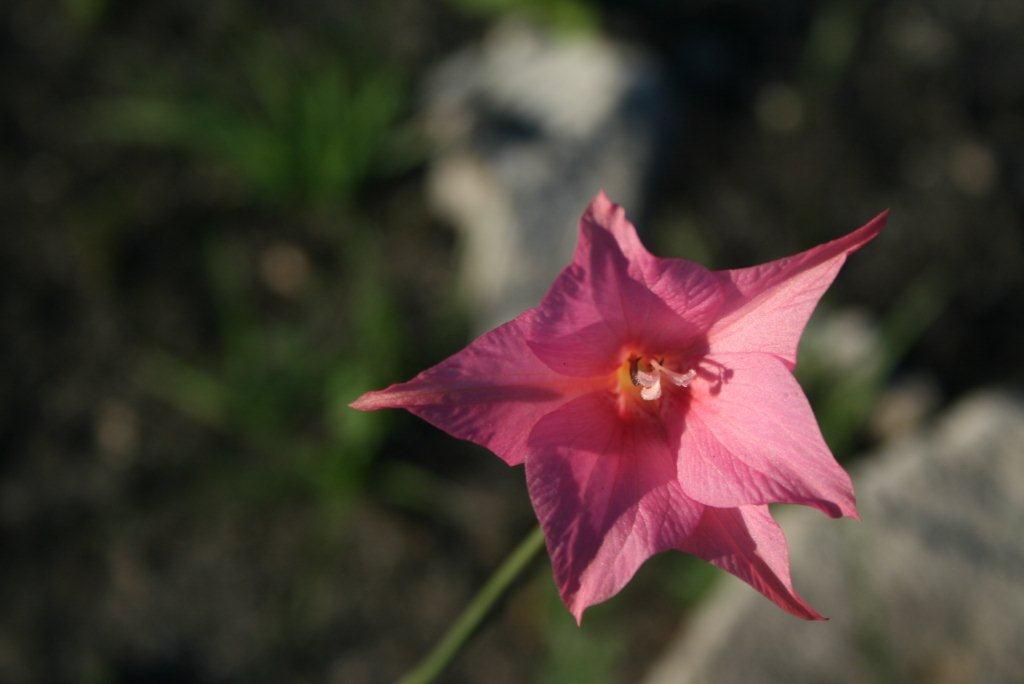
Despite the small size of the remaining area of Overberg renosterveld, new species continue to be found, highlighting the conservation value of every remaining patch. One of these new species that was recently discovered by our Trust Director, Odette Curtis, is a new species of Hesperantha.

Preview image


Together with Fauna and Flora International, the Trust is auctioning the naming of this new species. This is a great opportunity to have your name, or that of a loved one, immortalized by giving a name of your choice to this newly discovered species of beautiful South African iris. All proceeds of the auction will go to the Overberg Lowlands Conservation Trust and Fauna and Flora International.

Posted in Conservation, News, Working with fynbos | 1 Comment