Fire Diary – Week 2 after the fire

In the second week after the fire grasses and restios are already shooting and a number of spectacular flowers make their appearance in the landscape. Shoots appear from the burnt out bases of the large thatching reed Thamnochortus erectus.

Thamnochortus erectus sprouting after fire on Grootbos

The yellow flowers of the fire daisy Mairia coriaceae erupt from the charred and blackened landscape.

The fire daisy Mairia coriaceae flowering on GrootbosThe endangered (witbergpypie) is restricted to the area between Betty’s Bay and Potberg and also made its appearance on the the upper slopes of Grootbos in the second week after the fire.

Continue reading

Posted in Fire diary | Leave a comment

What’s flowering – Holothrix schlechteriana

This photos was taken by Heiner Lutzeyer on Grootbos today. It is the delicate ground orchid, Holothrix schlechteriana. Not much is known about the ecology or pollination biology of this genus but it is characterised by being drought resistant. Holothrix schlechteriana grows in isolated, small populations from Namaqualand to the Eastern Cape. It has green sepals and petals. The petals have 4-9 thread-like lobes and the lip is spurred and divided into 5-11 thread like lobes. It flowers from October to February and grows on sandstone soils.

Holothrix schlechteriana flowering on Grootbos Nature Reserve

Posted in What's flowering | Leave a comment

Whats flowering – Nivenia levynsiae

I was wondering around Cape Nature’s awesome Kogelberg reserve on Friday when I came across this magnificent Nivenia levynsiae in full flower. According to the latest Red Data book of South African plants it is a rare species that is restricted to sandstone outcrops between Kogelberg and Kleinmond. It belongs to a group of plants known as woody irises. They are true shrubs with woody stems with a hard, brittle texture. They grow from this woody underground caudex that is resistant to fire. There are ten species within Nivenia of which two occur in Kogelberg, the other being the rare Nivenia stokoei. The genus is pollinated by flies of the family Nemestriniidae and by long-tongued bees belonging to the family Anthophorideae.

Nivenia levynsiae in Kogelberg Nature Reserve

Cape Nature’s Kogelberg Nature Reserve is a must for fynbos lovers and is situated in the heart of the Kogelberg Biosphere Reserve, about 8 km west of Kleinmond and some 90 km from Cape Town. You can access it from the (R44) coastal road where a gravel road leads for 3 km through private property to the entrance.

Posted in What's flowering | Leave a comment

Fire Diary – week 1 after fire

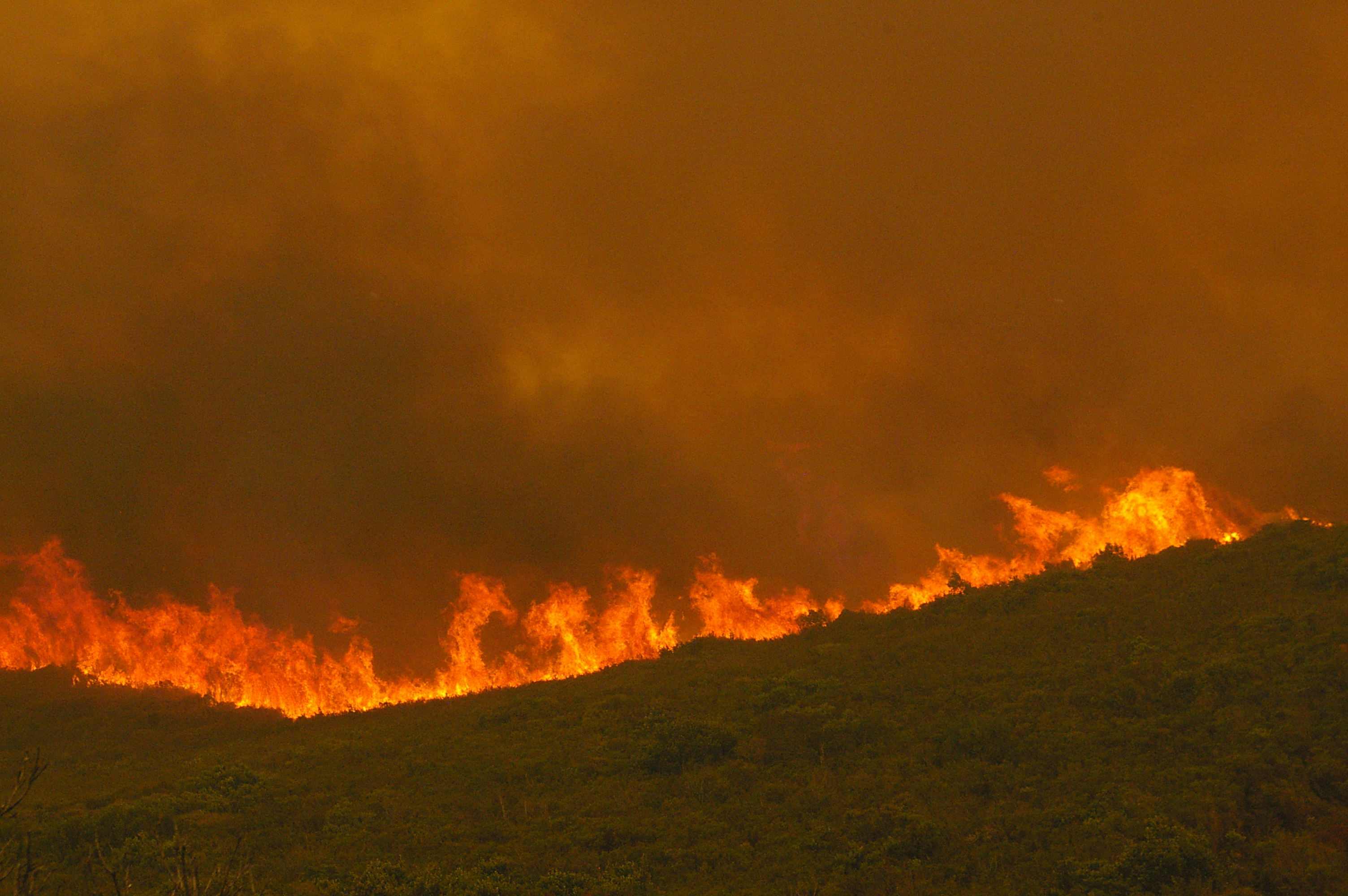
One week after the fire and some forty thousand hectares looked like this – a charred, desolate wasteland.

fire in walker bay

Yet already the process of regeneration was well underway. Far from destruction, what we were about to witness was amazing regeneration and an extraordinary explosion of life out of the ashes. Just one week after the blaze and enter Haemathus sanguineus, the April Fool or paintbrush flower.

Haemanthus sanguineus flowering in the fynbos on Grootbos

In between fires this spectacular bloom is seldom seen. Each year it produces two large, leathery, tongue shaped leaves that lie flat on the ground and produce food reserves for the large underground bulb. Each year the leaves dry up in early summer leaving no above ground evidence for this plant. A summer fire such as we experienced in February 2006 is exactly the trigger needed and these spectacular crimson red blooms appeared all over the charred landscape. It is a favourite for sunbirds and the seeds mature ready for germination just in time for the first winter rain showers.

Posted in Fire diary | Leave a comment

Fynbos Fire Diary – the day after the fire

When the smoke cleared the entire Grootbos Reserve, with the exception of a few forest patches, had gone up in smoke. What remained was a smouldering, desolate landscape. The Forest Lodge as well as three of the luxury free standing suites had been destroyed.

Given the enormity of the fire it was surprising how few dead animals we found. Somehow the vast majority of mammals and reptiles are able to escape even a fire as large as this. We were amazed to find tortoises trundling along in the middle of this massive, blackened landscape and Grysbok recovering amongst the burnt out Protea skeletons!

Already, within a day of the fire millions of Protea and Leucadendron seeds were being released from the protection of dried out flower heads on the dead parent plants. These were blowing with the wind and collecting in depressions on the ground.  

protea seed released after fire on Grootbos Nature Reserve

grysbok in burnt fynbos on Grootbos

Posted in Fire diary | Leave a comment

What’s flowering – Roella incurva

Here we are in the middle of summer having barely seen rain in the last three months yet the fynbos is still able to produce some real beauties. TAn example is this Roella incurva, which is brightening up the lower hills on Grootbos at the moment. It can have white flowers, but at Grootbos and other sites in the area where I have seen it, it has these purplish-blue flowers with dark blotches on the rim of the petal cup. It flowers in mid-summer when there is less competition from other plants for pollinators such as the bee visiting this flower. The bee is a Cape honey bee (Apis mellifera capensis). A rather unique bee that has the capacity for laying workers to produce fully functional queens from unfertilized eggs!

.Roella incurva with cape honey bee

Posted in What's flowering | Leave a comment

Why garden with fynbos?

There are many reasons why people living in the Cape region of South Africa should be planting fynbos in their gardens. Planting fynbos is a great way of helping to conserve and promote the rich and threatened flora of the region. Planting fynbos also attracts birds and other wild life to the garden. Fynbos plants are thrifty with water and are adapted to the climate and soils of the region. However, as I have learnt many times over the years, choosing the correct fynbos species for the local climatic and soil conditions is a crucial step in successful fynbos gardening. Many enthusiastic would-be fynbos gardeners have been horribly disappointed when most of their selection of plants bought from the local nursery dies within a few months of planting. The reason we have over 9000 species of plants growing in the Cape is largely to do with the many habitat ‘niches’ that characterise the region. While there are some common fynbos horticultural species that are able to grow in a wide range of soils and climatic conditions such as Agapanthus praecox, Elegia (Chondropetalum) tectorum, Protea cynaroides (King protea) and Osteospermum (Chrysanthemoides) moniliferum (bietou), the vast majority have quite specific preferences as to where they like to grow. gardening with king protea (Protea cynaroides)

Protea cynaroides (king protea) is South Africa’s national flower, is prized world-wide as a cut flower and is an iconic fynbos gardening species. It has the widest distribution range of all Proteaceae growing on mountains from the Cederberg to Grahamstown. The combination of different climatic and soil conditions over this large range has resulted in a large variety of leaf- and flower sizes, as well as colours and flowering times. The different forms retain these characteristics even when grown under the same conditions on a commercial scale.

There have been a number of ecological studies that have demonstrated that fynbos species are often adapted to very specific, narrow habitat characteristics. So the first step in successful fynbos gardening is to take a careful look at your gardens soil and climatic conditions. In order not to over complicate matters I have simplified the literally thousands of fine-scale habitats to four main groups for gardening purposes. These are acidic mountain fynbos gardens, alkaline coastal fynbos gardens, clay soils fynbos gardens and wetland fynbos gardens. In the next few fynbos gardening blog posts I will discuss each of these categories in more detail.


Posted in Fynbos Gardening | Leave a comment

What’s flowering – Watsonia schlechteri!

Watsonia schlecteri floweringThis beauty is flowering at the moment on Grootbos. It has bright red-orange flowers that are pollinated by sunbirds. It is most commonly seen after fire as the fire stimulates flowering but it can bloom in mature vegetation providing surrounding plants are not too tall. The Watsonias are part of the Iris family (Iridaceae) and are restricted to southern Africa where the majority of species are found in the Cape winter rainfall area. Watsonia schlechteri  is mountainous species that extends from Bain’s Kloof and the mountains around Ceres to Cape Hangklip and east to the Langeberg and Rooiberg to the Kammanassie and Kouga mountains in the southern Cape. It was named in honour of Rudolf Schlechteri, the late nineteenth century plant collector and botanist, who was one of the first to record this species. It flowers from late November to February.

Posted in What's flowering | 1 Comment

The conservation predicament

I have just had an interesting week on the farm that has really tested my conservationist heart! I bought Witkrans farm a few years ago primarily because of my love for nature and the fynbos in particular. Witkrans is situated in the beautiful Flower Valley behind Gansbaai  and we are surrounded by magnificent fynbos and wildlife. As part of the purchase agreement we happily agreed with the previous owners (Fauna and Flora International) to placing title deed restrictions on the property that would ensure the conservation of the natural veld in perpetuity, we cleared all the exotic invasive trees that were throttling the fynbos and I started photographing and documenting our fynbos and wildlife.  Continue reading

Posted in Conservation, Featured | 3 Comments

Fynbos gardening

Horticulturally, the raw genetic materials of the Cape plants have produced countless showy ornamentals that are now prized in gardens throughout the world. Dutch and German plant breeders have created a multi-billion dollar horticultural industry based on fynbos plant species. In the Cape there has been a growing awareness as to the value of our indigenous flora in gardening. Local indigenous plants are well adapted to the climate and other local environmental conditions, generally require less watering and care and are a great way of attracting indigenous wild life back into the garden. What’s more we have a wonderful selection of indigenous plants for virtually every gardening requirement and these are generally becoming more available through local retail nurseries.

Posted in Fynbos Gardening | Leave a comment