Fire Diary – week sixteen

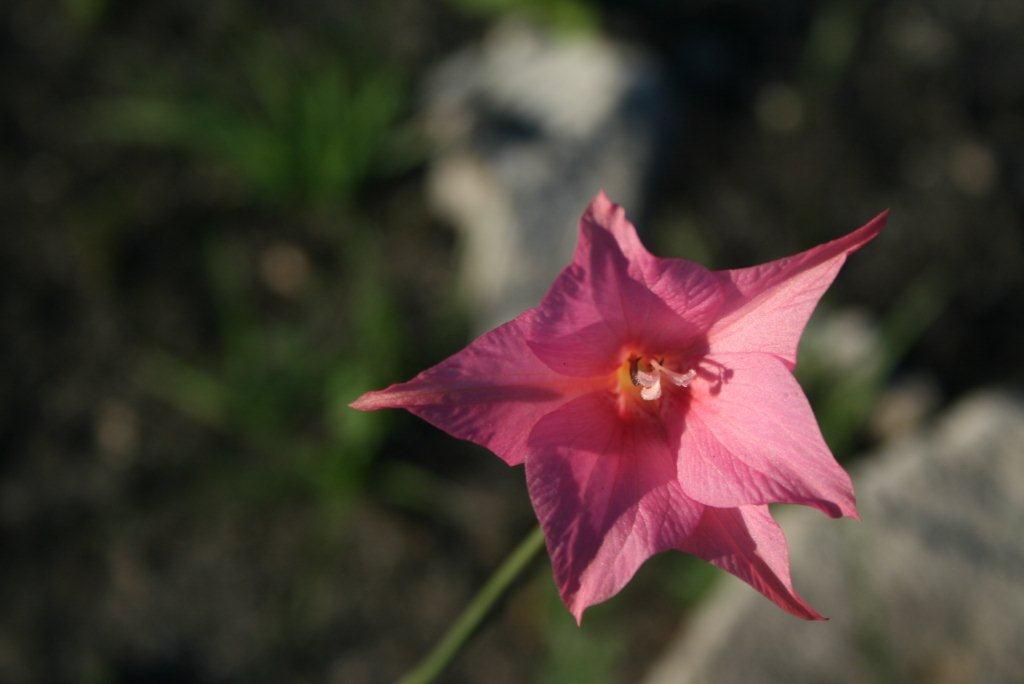
Some four months after the fire and following good autumn and early winter rains the landscape is full of floral surprises. Splashes of pink on the upper sandstone slopes turned out to be these beautiful pink flowered Gladiolus meridionalis.
Gladiolus meridionalis on www.fynboshub.co.za
This large flowered Gladiolus is adapted to sunbird pollination. It has a long flower tube with large quantities of sucrose dominant nectar hidden at the bottom of the flower. A feast for a hungry sugarbird!

A bit lower down, on sandier soils, were these hedgehog lillies, Massonia pustulata.

Massonia pustulata on fynbos hub blog
This species is a low, ground-hugging, bulbous plant characterised by two broad, flat, leathery leaves that have rough, blistered (pustulate – hence the species name) upper surfaces. The rivulets formed on this upper surface capture condensation and channel moisture to the bulb. The flowers are densely clustered between the two leaves and are creamy-white, pink or yellow. It is pollinated by honeybees and butterflies in search of the nectar held in the bottom of the long floral tubes. It is widespread and relatively common from Namaqualand to Port Elizabeth and the Karoo.

The bright red flowers of Lachenalia rubida were abundent in the deep sands near to the Walker Bay coastline in the first wineter following the fire. This species has one or two lance- to strap-shaped leaves that are plain green or spotted with darker green or purple. It is a species of the coastal sandy flats from Hondeklip Bay to the Cape Peninsula and eastwards to George.

Lachenalia rubida on www.fynboshub.co.za

Posted in Fire diary | Leave a comment

What’s flowering – Protea speciosa

I was up on Swartkransberg overlooking Walker Bay on the weekend and came across Protea speciosa in full flower. It has leaves with thickened margins that are 90-160 mm long and 10-60 mm wide. The flowerheads have closely packed brown fringed flowering bracts giving the plant its common name the brown beard sugarbush. It is a resprouting species that is able to survive fire and resprout from its woody underground stem. Typical of sprouting proteas it is seldom seen in dense colonies but rather as scattered plants. It is restricted to acidic soils from the Cape Peninsula to Bredasdorp. 

Protea speciosa on fynbos hub

Posted in What's flowering | 1 Comment

What’s flowering – Gladiolus brevifolius

Gladiolus brevifolius on fynboshub.co.za

This late summer/autumn flowering Gladiolus (pypie) has relatively small (30-40mm) flowers and does not grow to a height of more than about 85 cm. On Grootbos and surrounding areas it has pink flowers, although elsewhere the flowers can vary in colour from cream to mauve. The lower tepals usually have a yellow band edged in darker pink. It is usually leafless when flowering, except for the sheathing leaves on the stem, the lowest of which is rust-tipped. The single, usually hairy leaf is produced only after flowering is over. It is unscented, grows mainly on sandstone soils and is found between Piketberg and Cape Agulhas.It is one of the many Cape bulb species that has become a popular horticultural plant around the world.

Posted in What's flowering | Leave a comment

Fire Diary – week 11

By mid-April the first good rains had fallen, the temperatures were dropping and the blackened landscapes were now rapidly becoming covered in fresh, young vegetation. The photo below shows the fast regrowth of the resprouting Olea capensis ssp. capensis as well as asparagus and the grass Cymbopogon marginatus on the ridge below Swartkransberg.

Overberg sandstone fynbos after fire on Grootbos

A closer look at the landscape revealed some flowering gems including the resprouting Liparia splendens (the mountain dahlia) and Gerbera piloselloides (swarttee).

The mountain dahlia Liparia splendens flowering on Grootbos

Liparia splendens subsp. splendens, or the Mounatin dahlia as it is cmmonly known, is an creeping shrubs that is found on the higher peaks in the Walker Bay region where it is mostly found in rocky outcrops. As a species that resprouts after fire, the rocks provide some degree of protection for the undreground lignotuber from fire. Liparia seeds have a fleshy collar-like aril that attracts ants that disperse seeds underground. This dispersal strategy using ants is known as myrmecochory.  

Gerbera piloselloides (swarttee) flowering on Grootbos on fynboshub.co.za

Gerbera piloselloides (swartee) is a tufted perennial with a rosette of elliptical leaves that are softly cobwebby on both surfaces. It tends to be overshadowed by larger fynbos plants in mature veld. As such it loves fire, and is one of the first species to flower in the autumn after a burn. It has a natural distribution from the Cape Peninsula to tropical Africa.

Posted in Fire diary | Leave a comment

What to plant under Eucalyptus trees?

Eucalyptus or blue gum trees have been planted all over the Cape providing effective woodlots, a source of poles for fencing, food for bee’s and shade and wind breaks. I am often asked what indigenous plants can be planted under these water-sucking, fynbos bashing bullies. While I generally recommend removing them, this is often not practical as trees are not easily replaced in the Cape and should be gradually removed as indigenous trees establish. One indigenous plant that has proven tough enough to survive these Aussie canopies is Plumbago auriculata. The photo below is taken in the Grootbos garden where I planted these Plumbago’s under a row of Eucalyptus gomphocephala ten years ago. The Eucalyptus provide shade, a green screen and a home for hundreds of Cape Weaver birds each spring but surpressed all undergrowth resulting in a barren, wind-swept sandy floor. The Plumbago has done a great job in filling this gap and flowers through the dry summer months when little else is flowering.

Plumbago auriculata and Eucalyptus gomphocephala on fynboshub.co.za

Posted in Fynbos Gardening | Leave a comment

What’s flowering – Brunsvigia bosmaniae

I was fortunate enough to spend the last few days in the Cederberg Mountains, one of my favourite places to hike, swim, mountain bike, botanize and relax. We drove along the back route via Ceres and the Koue Bokkeveld and came across thousands of these beautiful Brunsvigia bosmaniae flowering in the dry karoo landscape.  While I have seen photos of there magnificent flowers in books, this was my first ‘live’ show and the sheer exuberance of these plants flowering en masse was something to behold. Without doubt this is a natural spectacle not be missed and is well worth the long gravel road and many corrugations of this route. 

Brunsvigia bosmaniae on fynboshub

The flowering heads function highly effectively to disperse seeds.  Anyone who has seen the dried flower heads rolling around the veld will appreciate how perfectly these species are suited to wind dispersal. Brunsvigia bosmaniae flowers from March to May mostly on gravelly soils from Namaqualand to Tygerberg and the Bokkeveld plateau (where these photo were taken) to the Roggeveld. Below is photo of a white flowering individual taken at the same time.

Brunsvigia bosmaniae - what's flowering on fynboshub.co.za

Posted in What's flowering | 1 Comment

Tough but beautiful autumn bulbs in the fynbos

Here are two autumn flowering beauties I came across while hiking in Kogelberg last week. Amazingly both had survived many decades under pine plantations! Following a fire and removal of the pines last year they are in full bloom for the first time in many years. The first is Tritoniopsis ramosa which grows on sandstone slopes from the Cederberg to Humansdorp and is adapted for pollination by long-proboscid flies. 

fynboshub.co.za

 A few meters away next to a giant burnt out Pine stump, I photgraphed this fragile Bulbinella trinervis. It is unscented and grows in rocky sandstone areas from Malmesbury to the Baviaanskloof Mountains. The genus Bulbinella has an interesting and very unusual distribution with most being restricted to the winter rainfall region of the Cape and six occuring naturally in New Zealand!

fynbos rehabilitation

It really is remarkable how reslient most fynbos species are to surviving under plantations or  invasive exotic trees.

Posted in Diversity, Ecology, What's flowering | Leave a comment

What’s Flowering – Erica coriifolia and Erica canaliculata

In the last week I was fortunate enough to spend time in the Kogelberg Biosphere Reserve as well as in the foothills of the Tsitsikamma range at Milwood, north of Knysna. I was quite confused by this large flowered Erica coriifolia flowering profusely in the Kogelberg.

Erica coriifolia flowering in the Kogelberg Biosphere Reserve

It is difficult enough to identify the different species amongst the many pink erica’s in the fynbos and then you still get such variability within a species! This beautiful pink-flowered erica grows over a wide range of conditions from high in the mountains to low sandy flats and covers an area from Ceres in the north, including the Hex River Mountains to the Cape Peninsula and eastwards to the Riviersonderend and Langeberg ranges from Robertson to Riversdale as well as the mountains around Bredasdorp. I am used to seeing it at this time of the year flowering in the mountains on Grootbos Nature Reserve and in the Walker Bay region, where it has much smaller, more compact flowers as shown below. Erica coriifolia is distinguished by its urn-shaped corolla that turns brown soon after opening.

Erica coriifolia flowering on Grootbos

While mountain biking near Milwood today I came across another pink Erica. Erica canaliculata is a large ‘bush erica’ that grows on forest edges and in gullies and kloofs between George and Port Elizabeth. It is a very striking plants that is covered in flowers between November and April and can reach 5 m!

Erica canaliculata growing on the mountain bike trail near milwood

The very long, protruding styles help to distinguish this species.

Erica canaliculata flowering on the milwood forest mountain bike route

Posted in Uncategorized | Leave a comment

Helicopters or jobs?

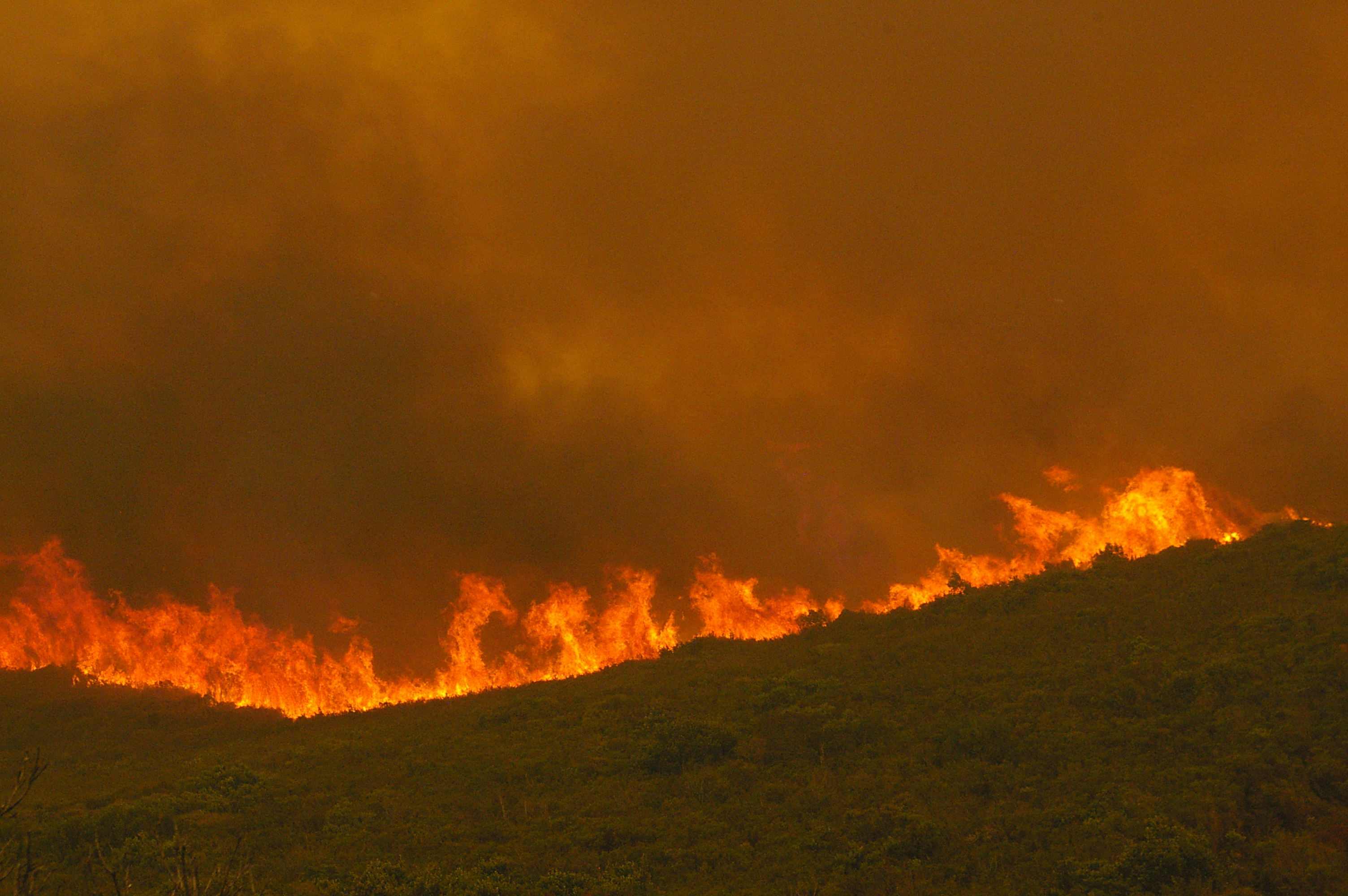
It was once again fire time in the Overberg last week with a big burn in the Kogelberg and a flames licking on the edge of Gansbaai and Dekelders. The Gansbaai fire burnt in dense rooikrantz (Acacia cyclops) threatening the village and resulting in a helicopter being brought in to bomb the flames to protect the town. It seems crazy that tens of thousands of rands had to be spent on hiring a helicopter when the major threat was the result of highly flammable alien invasive trees. With our president focusing on our countries high unemploymnet and the need for job creation in his state of the nation address we spend thousands of rands on helicopters to fight fires, where this money would be much better spent on providing jobs to clear alien vegetation and thereby drastically reducing fire threats. The Gansbaai fire threatened the Masakhane township which is home to many unemployed people and is completely surrounded by rooikrantz. These mature rooikrantz stands are three meters plus in height and highly flamable compared to the natural strandveld vegetation which barely reaches a meter in height. Its time for the local municipality and private landowners in the region to make a serious investment in clearing this threat, restoring the areas unique natural biodiversity and creating jobs for the poor.

fire in rooikrantz

Posted in Conservation, Featured, Fire diary | Leave a comment

Fire diary – 21 March

fynbos after fire on Grootbos

You can see from the photo above our post-fire landscape is still looking rather bare, but there are some traces of green appearing despite no rain having fallen.  However on closer inspection a number of plants had already re-sprouted and were in full flower. Below is a photo of the beautiful Kniphofia uvaria (red hot poker) that was photographed in full bloom just seven weeks after the fire.

red hot poker on Grootbos

Another species already flowering was Mairia coriacea (fire daisy), a species restricted to rocky sandstone slopes between Rooiels and Potberg that flowers profusely imediately following fire.

fire daisy (Mairia coriacea)

Posted in Fire diary | 1 Comment