Post-doctoral opportunity at Nelson Mandela Metropolitan University, Port Elizabeth: Closing date 28th Otcober

Nelson  Mandela  Metropolitan  University, in collaboration with Arizona State University, wishes  to  appoint  a  post-doctoral  fellow  specializing  in vegetation and species distribution modelling, as well as phylogeography, whose research will focus on the Quaternary history of vegetation along the southern and western coastal lowlands of South Africa.  For more information see attachment below.

NMMU postdoctoral opportunity

Posted in Bursaries and job opportunities | Leave a comment

Vacancy: Conservation Field Officer (closing date 20 October 2011)


Please can you distribute this advert for the position of Conservation Field Officer with the Cape West Coast Biosphere Reserve to the Fynbos Forum network? Closing date 20 October 2011.

Conservation Field Officer advert

Regards

Rhett

Posted in Bursaries and job opportunities | Leave a comment

SAAB Conference UP 2012 – REGISTRATION and ABSTRACT submission OPEN

Dear SAAB members, Botanists/Plant Scientists, Students etc.

Please find attached the 2nd Circular for the SAAB Conference to be hosted by the Department of Plant Science at University of Pretoria from 15 – 18 January 2012. Registration is now open at http://www.up.ac.za/plantscience The deadline for registration and submission of abstracts is 15 October.

 SAAB 2nd circular

Kind regards

Marion Meyer

VISIT OUR NEW WEBSITE —-BIODIVERSITY ADVISOR—- ON HTTP://BIODIVERSITYADVISOR.SANBI.ORG/

Posted in Events and conferences, News | Leave a comment

Spring bulbs in the Overberg

We have had a wonderful spring for flowering annuals and bulbs in the Overberg this year. I think it is a combination of good rains in June and the fact that we are now five years since the last fire and the veld, while maturing, is still providing sufficient open spaces for the small guys. I took a walk on Monday over Witkrans, Flower Valley and Grootbos and came across some beautiful spring bulbs in full bloom. Take a look below at just a small selection of what is flowering at the moment……..

Moraea papilionacea on www.fynboshub.co.za

Moraea papilionacea is a low (to 15 mm), spring flowering Moraea with sweetly scented flowers that are salmon pink or pale yellow, with yellow nectar guides on the outer tepals outlined in yellow, green or red. It grows from the Cederberg Mountains to Bredasdorp on a variety of soils.

Gladiolus carneus of www.fynboshub.co.za photographed at Witkrans farm


This Gladiolus carneus was a complete surprise to me when I found it flowering in a damp area above our dam on Witkrans. I have walked this area many times before in spring and never seen this plant. Its common name is the painted lady or white Afrikaner and it can usually be recognised by its large, funnel-shaped pale pink or white flowers, often with dark linear to spear-shaped markings on the lower tepals. It grows to 60 cm and occurs on sandstone slopes, often in damp sites from the Cape Peninsula to Outeniqua Mountains.                 

Gladiolus debilis on www.fynboshub.co.za

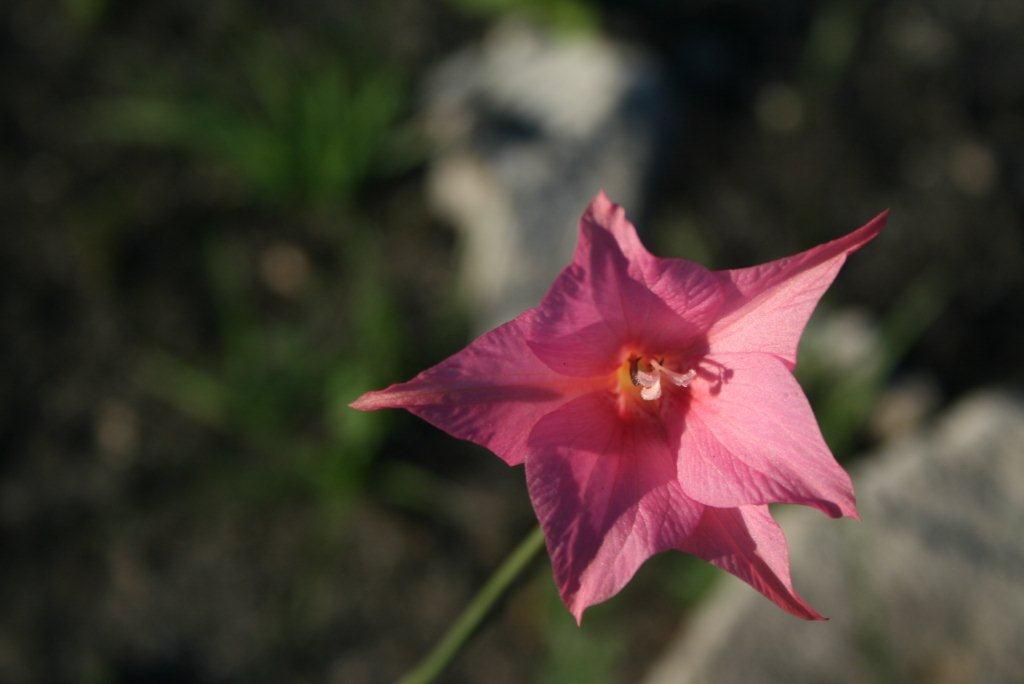
The little painted lady, Gladiolus debilis is superficially similar to Gladiolus carneus. It is however much shorter (to 45 cm). Its lower tepals are characterised by their distinctive red markings including chevrons, diamonds or streaks and lines in very regular patterns. The base of the throat is also marked with a circle of red. It grows on sandstone slopes from Bainskloof to the Cape Peninsula and Bredasdorp.

Gladiolus variegatus on www.fynboshub.co.za

Aother similar, and equally beautiful spring flowering Gladiolus of the Overberg is Gladiolus variegatus. This species also has white flowers with the lower tepals having irregular red spots. However this species is easily distinguished from the two above by its localised distribution on limestone outcrops in the region between Grootbos and Cape Agulhas. Unfortunately its habitat is threatened by alien vegetation and coastal housing development. As a result it is categorised as a vulnerable species according to the latest Red Data list of south African plants.

Gladiolus miniatus on www.fynboshub.co.za

Another rare endemic of the limestone outcrops along the south coast is this Gladiolus miniatus. It has unmistakeable salmon-orange flowers, usually with darker colouring in the midlines.  The flowers produce copius amounts of nectar and it is thought to be pollinated by sunbirds. This species grows between Hawston and Riversdale, usually near the shore in sight of the ocean.




Posted in Diversity, What's flowering | Leave a comment

FYNBOS FORUM 2012 DATES AND VENUE FOR YOUR DIARIES NOW!

Dear Fynbos Forum Friends

The Fynbos Forum Committee are very excited to announce that the Dates and Venue for Fynbos Forum 2012 have been decided –SO please put these in your diaries/electronic diaries/cellphones etc  NOW!

DATES: Eve of 16TH July 2012 to eve of 19th July 2012 (So we only start with registration on the eve of 16th; workshops, presentation, posters, fieldtrips on the next few days; and finish on the eve of the 19th) giving you time to get there on the 16th, and time to get back home on the 20th.

VENUE: Cape St Francis…

ACCOMMODATION: is at the conference venue, and we are working on special rates for all.  So do not yet attempt to do any bookings!

THEME: “East meets West: transcending political, ecological and social boundaries in the fynbos”

BUT PUT THE DATES IN YOUR DIARIES AND WE WILL KEEP YOU POSTED!

Warm regards


The FF Committee, and yours truly!

Posted in Events and conferences | Leave a comment

So where do your chips come from?

A few weeks ago I was fortunate to spend a couple of days on a search and rescue project transplanting rare plants from quarry sites and along the road verges between Paleisheuwel and Graafwater up the West Coast. This area is in the heart of the sandveld, a very special fynbos area that is the second most threatened ecosystem in South Africa. The sandveld is home to some 58 rare and threatened plant species of which at least 30 are endemic (found nowhere else).

The main reason for this high number of rare anpotato fields on www.fynboshub.co.zad threatened plant species is the clearing of natural vegetation for potato farming. Potato farming is the core economic activity and employer in the sandveld producing an annual turnover of some R400 million and employing over 3200 people. Certainly a lot higher than any tourism or other more sustainable economic activity related to the regions special flora! The five year rotation cycle required to combat the impacts of soil-borne diseases means that the industry footprint is very large and growing.

Howevsandveld potatos on www.fynboshub.co.zaer with every new circular field cleared for planting potatoes more and more of the regions unique natural heritage is lost. While I have previously read and heard people talk about the threats posed by the potato to the strandveld, my few days working along the Paleisheuwel road really brought the reality of the situation home. All along the road are huge circular fields full of yummy potatoes, surrounded by natural sandveld which in early September was full of amazing flowering bulbs, annuals, succulents and shrubs.

One of these rare sLeucadendron brunioides var. flumenlupinum on www.fynboshub.co.zapecies that I came across was Leucadendron brunioides var. flumenlupinum. While it may have a long and rather elegant name, it is very rare! According to the Sasol Proteas field guide it is known from a single population of about 100 plants at Jakkals River near Graafwater. I encountered 50 plants perched precariously above one of the gravel borrow pits. The plants have their roots in some high quality road making material and were thus in the path of the proposed borrow pit extension and a pretty serious looking bulldozer. Fortunately we were able to change the direction of the quarry extension and save them from being flattened for now. But the issue is that unlike the environmental regulations required for road making, a lot of ploughing for new potato fields is still happening in the sandveld without specialist botanical input. 

So that evening while I enjoyed a cold Windhoek Lager and ribs at a harbour restaurant overlooking the cold Atlantic Ocean at Lamberts Bay, I could not help wondering where did my chips come from.

Posted in Conservation, Working with fynbos | Leave a comment

Biodiversity and Red Meat Stewardship Initiative. (BRI)

The Biodiversity and Red Meat Stewardship Initiative (BRI) is looking for an extension officer to be based in Springbok. For more information on this post see BRI STEWARDSHIP EXTENSION OFFICER (finale)

Posted in Bursaries and job opportunities | Leave a comment

The silver-edge pincushion – a story of sugarbirds, ants and fire

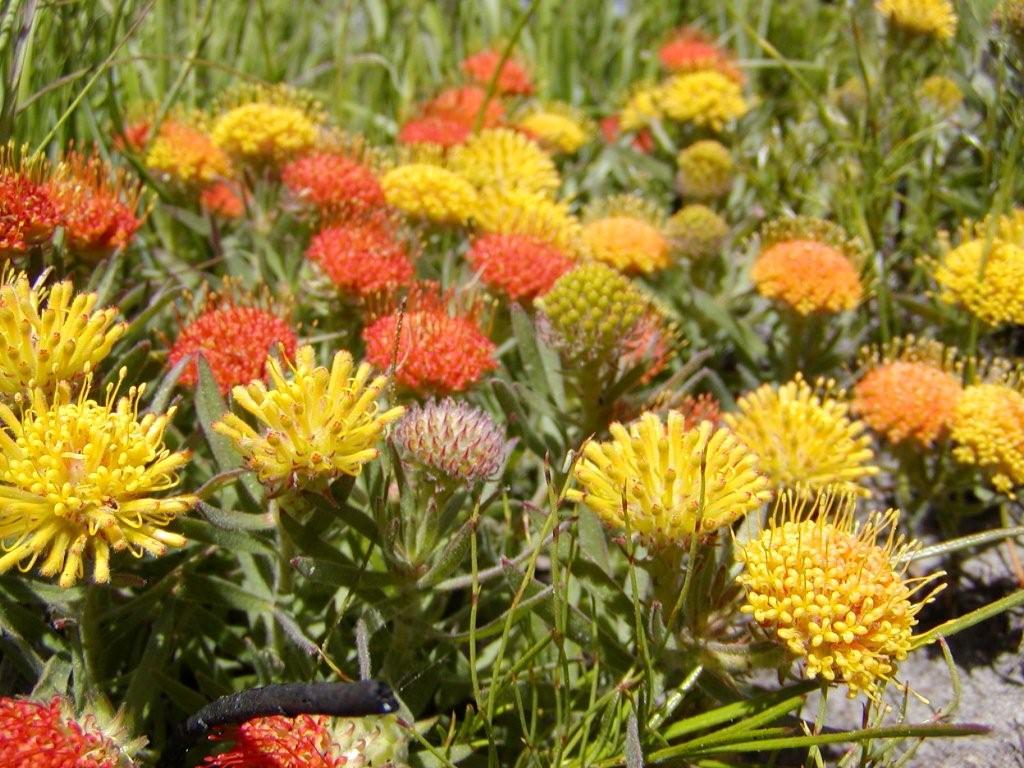
Leucospermum patersonii on www.fynboshub.co.za

The bright orange flowers of Leucospermum patersonii (the silver-edge pincushion) act as a ‘landing pad’ for sugarbirds which delve down into the flowers with their long beaks to extract nectar.

The pollen is placed onto the birds heads by the long incurved styles. The plant only produces a few large, precious seeds per flower head. These ripen by late summer and drop to the ground where their waxy elaisome (seed cover) attracts indigenous ants who carry the seed underground into their nests.


myrmecochory on www.fynboshub.co.za

Once in the nests, the ants devour the energy-rich seed coating, leaving the seed safely ‘planted’ out of harms way. Ants are respeonsible for dispersing approximately 170 species of Proteaceae and many other plant species in the fynbos. The seeds lay dormant underground until nutrients fromthe ash of bush-fires leach down through the earth. These nutrients, together with sufficient moisture and cool winter temperatures break the seeds dormancy, causing the seeds to germinate in the first winter following fire. Without the sugarbirds, the ants, the fire and our cool Cape winters, this species would be unable to reproduce and play its crucial role in the ecology of the fynbos.

Posted in Diversity, Ecology, What's flowering | Leave a comment

Thicket Forum Conference – 2 & 3 November 2011

 For information and registration for the 2011 Thicket forum conference see thicket forum 2011 and Thicket Forum Conference 2011 _ RSVP FORM (2)

Posted in Events and conferences, News | Leave a comment

Flowers, flowers everywhere

A walk in the mountains on the weekend reminded me that there is probably no better month than September for enjoying the fynbos. I took a walk on part of the new fynbos trail that will be opening shortly in the Walker Bay Fynbos Conservancy. This trail is 26 km long over three days with two beautiful overnight stops at Fynbos Retreat and Bodhi Khaya. It includes an amazing diversity of fynbos and forest habitats as well as spectacular views over Walker Bay and the surrounding landscapes. Below are a few pics of some of the flowers I came across on the trail, enjoy……..

Leucospermum patersonii at Fynbos RetreatLeucadendron tinctum on www.fynboshub.co.za


Dorotheanthus bellidiformis at Fynbos Retreat on www.fynboshub.co.za


Gladiolus debilis flowering at Fynbos Retreat (www.fynboshub.co.za)


Posted in What's flowering, where to see fynbos | Leave a comment