Postgraduate bursaries: SAEON Fynbos Node, closing date 10 January 2012

Please could you distribute this advertisement for 1 PhD and 2 MSc bursaries at the Fynbos Node of the South African Environmental Observation Network.

Students interested in studying global change in fynbos are encouraged to apply. For more inf click here SAEON Fynbos Node Bursaries 2MSc 1PhD 2012

Many thanks,

Jasper Slingsby

Posted in Uncategorized | Leave a comment

MSc bursary available, closing date 7 Dec. 2011

Dear Wendy

Please distribute this MSc opportunity, working towards the biological control of Acacia cyclops. Although within the discipline of Plant Pathology, undergraduate studies in this subject are not a prerequisite and candidates with a strong plant ecology or conservation background are welcome to apply. Biological control is a multi-disciplinary subject, and a broad background is a decided advantage.

Closing date: 7 Dec. 2011

Send applications to Dr Cheryl Lennox clennox.sun.ac.za

Thanks

Alan Wood

Posted in Bursaries and job opportunities | Leave a comment

What’s flowering – Lanaria lanata

The Cape Edelweiss (Lanaria lanata) is flowering in the young burnt vegetation around Kogelberg Nature Reserve at the moment.  It is an upright plant that reaches 80cm, with numerous stiff, narrow leaves at the base that arise from a woody rootstock. The densely woolly, white ‘balls’ of flowers are quite unique to the species. Hidden within these woolly, white heads are small, mauve flowers.

Cape edelweiss  It occurs on clay and sandstone slopes throughout the region between Bainskloof and Port Elizabeth, where its flowers are especially profuse in the first few years following fire.

Posted in Uncategorized | Leave a comment

What’s flowering – Lachenalia rosea and Lachenalia variegata

Lachenalias are members of the Hyacinthaceae family. There are some 66 species in the Cape flora, many of which have become popular horticultural species around the world. Two Lachenalia’s, Lachenalia rosea and Lachenalia variegata are flowering in Walker Bay at the moment.

Lachenalia rosea has narrowly bell-shaped, pink, or a combination of blue and pink flowers. It has two lance-shaped leaves that are plain or botched with maroon or brown markings. It is flowering at the moment and grows mainly in coastal sands from the Cape Peninsula to Knysna.

Another species flowering on the lower sandy slopes overlooking Walker Bay is Lachenalia variegata. This species has a single, lance, or strap-shaped leaf with thickened, undulating margins. The narrow, bell-shaped flowers are greenish grey with darker green, blue, purple, or brown markings and white tips. It grows mainly in deep coastal sands from Clanwilliam to Gansbaai.


Posted in What's flowering | Leave a comment

Flower Valley to host ‘Pick a Pincushion day’

You’re invited to join us for our first ‘Pick a Pincushion Day’, to be held on Flower Valley Farm near Gansbaai on Saturday, 26 November. For more information see Pick a Pincushion Day pDF or www.flowervalley.org.za.

Posted in News | Leave a comment

Fighting fire with bark

Leucospermum conocarpodendron is in full flower at the moment. I took this photo of a fine speciman above Somerset West in the fynbos overlooking the Da Capo vineyards ( on the lower slopes of the Hottentots Holland Mountains).

The area where the photo was taken was burnt in a massive fire earlier this summer and as a result most of the surrounding vegetation is low and either resprouting after the fire or only germinated from seed this winter. However in the middle of this low, early post-fire fynbos are these magnificent tree pincushions, perfectly intact and in full flower. How can this be?

Well virtually all fynbos plants are adapted in some way to survive fires. Leucospermum conocarpodendron is one of a few species that is able to survive fires by having thick, fire-protective bark.

The thick bark protects the stem and buds from fire. Over time plants that survive fire tend to develop an unbrella-shaped form as their lower branches burn off and new growth is produced from the surviving upper branches. Nevertheless, this species is not a resprouter and plants can and do sometimes get burnt and even die in fire.

A study I was involved in a few years back in the Cape of Good Hope Nature Reserve showed that long intervals between fire results in greater build up of fuel loads, leading to more intense fires and a higher liklihood of death in fire.  So thick bark only works with shorter, natural fire cycles. Hot fires resulting from excessive fuel build up because of long intervals between fires or invasion by alien plants can kill these beauties, but under natural fire regimes their thick bark provides them with the necessary defenses to survive most fynbos fires.

Posted in Ecology, What's flowering | Leave a comment

Spring splendour in the Kogelberg

The Kogelberg region of the Cape is generally accepted as the true heart of the Cape floral Kingdom, an area of unprecendeted floral diversity and natural beauty.  As a result some 100 000 hectares stretching from the coast (Gordons Bay to Kleinmond) inland to  Groenlandberg and Bot River has been proclaimed a biosphere reserve by UNESCO. See Kogelberg Biosphere Reserve  for more info.

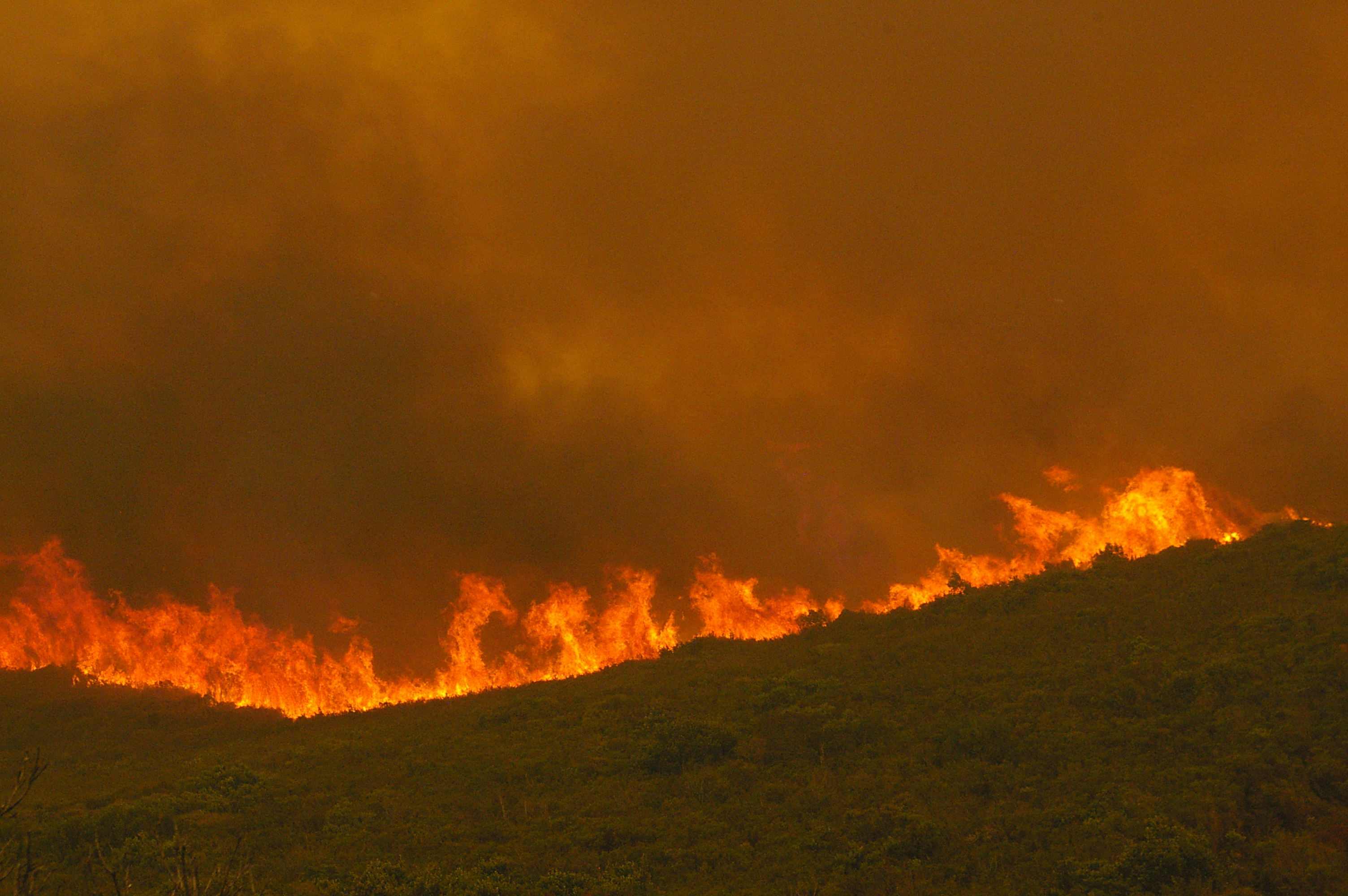
A huge fire at the beginning of this year resulted in most of the reserve being burnt and visitors to Kogelberg have been disappointed by blackened and burnt out landscapes. However with the winter rains and warm, sunny spring days this has all changed. The Kogelberg is once again full of colour as millions of bulbs, many of which have long been dormant, flourish in the nutrient-rich post-fire environment.

Over the last few weeks I have been involved with the landscaping and fynbos restoration at the Oudeberg Cabins near Cape Nature’s offices in the Kogelberg Reserve. It has been incredible to drive into to the Reserve each day and see the changing colours and bright splashes appearing and fading across the landscape as the different spring bulbs make their post-fire appearance.

At the moment there are three species dominating the show. The first and most specatcular is Pillansia templemannii. Pillansia templemannii a monospecific genus in the fynbosThis beautiful iris grows only on the lower stony slopes around the Kogelberg. What makes it very special is that it is what botanists term a mono-specific and endemic genus. What this means is that the genus only has one species and whats more that the genus and its single species are confined to the Kogelberg area – no where else on Earth! The loose clusters of long-lasting bright orange flowers are pollinated by bees and monkey beetles and turn the hills orange after fire. It is however seldom seen flowering between fires. So if you want to catch this spectacular flowering display, now is the time to visit the Kogelberg.

Another bulb species  producing spectacular flowering displaysWatsonia barbonica flowering after fire in the Kogelberg  in the Kogelberg at the moment is Watsonia barbonica, which is also most profuse in the first spring following fire.


This week when I arrived at the Reserve I was  met by a sea of yellow that simply was not there the week before. Over just a couple of days, millions of Wachendorfia paniculata (the rooikanol) had opened in a spectacular show of yellow.   


I cant wait to see what next weeks spring splendour in the Kogelberg has install!

Posted in Diversity, Fire diary, What's flowering, where to see fynbos | 1 Comment

Please not Bantamsklip

A recent article in the Botanical Societies Veld and Flora magazine written by Dave and Sue Whitelaw outlines the considerable threat posed by the proposed nuclear power station at Bantamsklip in the southern Overberg.  To read the full article click on the attachment: Botanical threat in Overberg

Posted in Conservation | Leave a comment

SANBi MSc bursary in Systematics 2012, Compton Herbarium Cape Town


A Masters project, funded through the South African Biosystematics Initiative (SABI) of the National Research Foundation (NRF), is available at the Compton Herbarium, Kirstenbosch Research Centre, Cape Town. The student will be registered at either the University of Cape Town or the University of Johannesburg. Click here for more info:

MSc bursary advert Systematics 102011

Title project: Taxonomic and phylogenetic studies of the southern African endemic subtride Phymasperminae (Asteraceae, tribe Anthemideae).


Posted in Bursaries and job opportunities | Leave a comment

Pincushion proteas that rely on rodents for pollination

While the fields of the large, showy pincushions such as the silver-edge pincushions tend to steal the show at this time of the year, there is a group of other, less obvious pincushion proteas that are also flowering – but much closer to the ground.

These are the ground-hugging, rodent pollinated varietes. Yes instead of large, brightly coloured showy flowers designed to attract sugarbirds for pollination, these guys flower at ground level and have sweet, yeasty smelling flowers that are great at attracting mice.

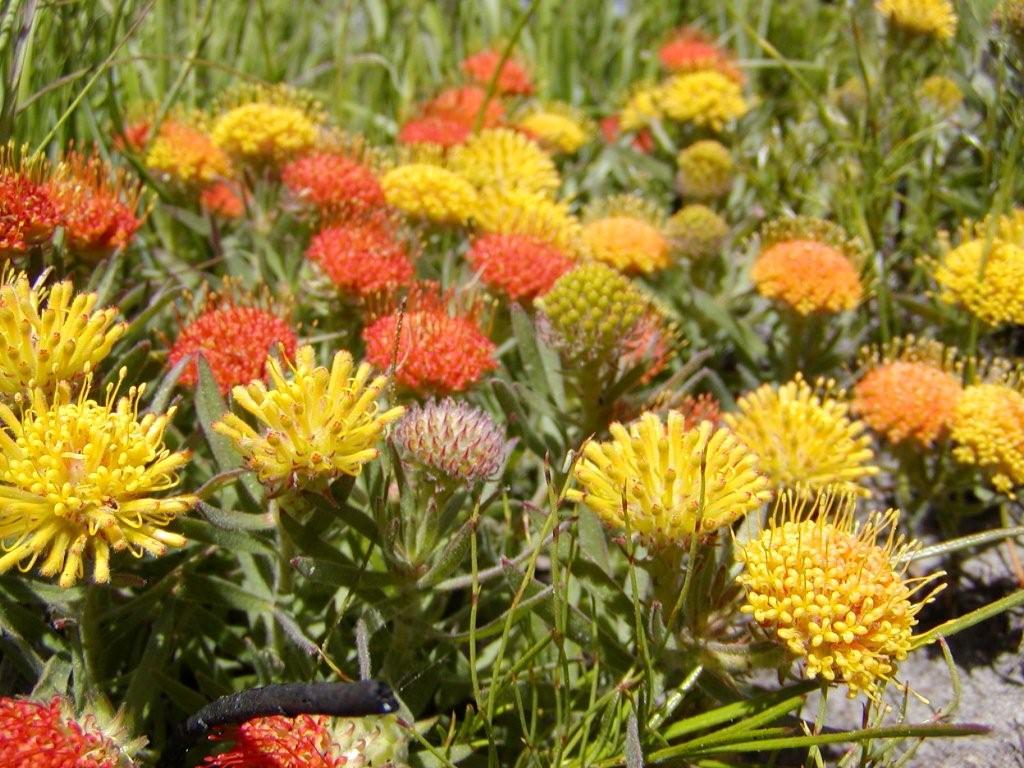
Three of these ground creeping pincushions flowering in the Overberg at the moment are the yellow trailing pincushion (Leucospermum prostratum), the white trailing pincushion (Leucospermum pedunculatum) and the rankluisie or trident pincushion (Leucospermum heterophyllum).

Leucospermum prostratum on www.fynboshub.co.za

The yellow trailing pincushion resprouts from an underground rootstock following fire and can form a large mat up to 4m wide. The linear leaves have pointed tips, and the dainty (25 mm), sweet scented flowerheads are bright yellow, turning orange as they mature. It grows in deep sands, mainly near the coast from the Kogelberg to the Elim hills and flowers from July to December.


Leucospermum pedunculatum on www.fynboshub.co.za

The white trailing pincushion is single stemmed (does not resprout after fire) and forms dense mats of up to 3m in diameter. It has bright, green leaves that are linear (30-60mm long, 2-5mm wide) and generally point upwards from stout, horizontal branches. It has small (30 mm) flowerheads that are creamy-white and turn carmine as they age. It grows in a narrow stip along the coast from Danger Point to the Soetanysberg and flowers from August to June.

Leucospermum heterophyllum photographed in Elim fynbos on Geelkop

The trident pincushion has been categorised as an Endangered species according to the latest Red List of South African Plants. This low (up to 150 mm high), ground hugging shrub forms large mats up to 5 m in diameter. It has stalkless leaves that have one to three glandular teeth at the tips. The flowerheads (25 mm wide) are yellow-green turning carmine as they mature. It is restricted to gravelly, clayey soils from Flower Valley near Gansbaai to De Hoop.


Posted in Diversity, Ecology, Featured, What's flowering | Leave a comment